
Mushroom coffee has become increasingly popular as a “functional” alternative to traditional coffee—often marketed for focus, energy, stress support, or immune health. These products typically combine coffee or coffee alternatives with functional mushroom extracts such as lion’s mane, cordyceps, reishi, or chaga.
While mushroom coffee can be a reasonable option for some individuals, quality and dosing vary widely, and many products do not deliver therapeutic amounts of mushrooms. Understanding when mushroom coffee makes sense—and when it doesn’t—is key for both clinicians and educated consumers.
What Is Mushroom Coffee?
Mushroom coffee refers to beverages that contain coffee (or coffee alternatives) blended with powdered or extracted functional mushrooms. Some products reduce caffeine content, while others simply add mushrooms to regular coffee.
These blends are often positioned as:
- A gentler source of energy
- A way to support focus or mental clarity
- A “healthier” coffee option
However, mushroom coffee should be viewed primarily as a beverage choice, not a treatment strategy.
What to Look for in a High-Quality Mushroom Coffee
Not all mushroom coffees are created equal. When evaluating products, the following criteria matter:
Ingredient Transparency
- Avoid proprietary blends
- Look for clearly listed mushroom species, extract type, and exact milligram dosing
- “Mushroom blend” without specifics is a red flag
Mushroom Quality
- Prefer fruiting body extracts over grain-grown mycelium
- Standardized extracts are preferred when available
- Organic sourcing is helpful but not sufficient on its own
Third-Party Testing
- Supplements are not FDA regulated
- Products should be tested for:
- Heavy metals
- Microbial contamination
- Pesticides
Coffee-Specific Considerations
- Coffee should ideally be tested for toxins and mycotoxins (such as ochratoxin A)
- Be aware of actual caffeine content, which is often underreported or unclear
Mushroom Coffee vs. Therapeutic Mushroom Supplementation
This distinction is critical.
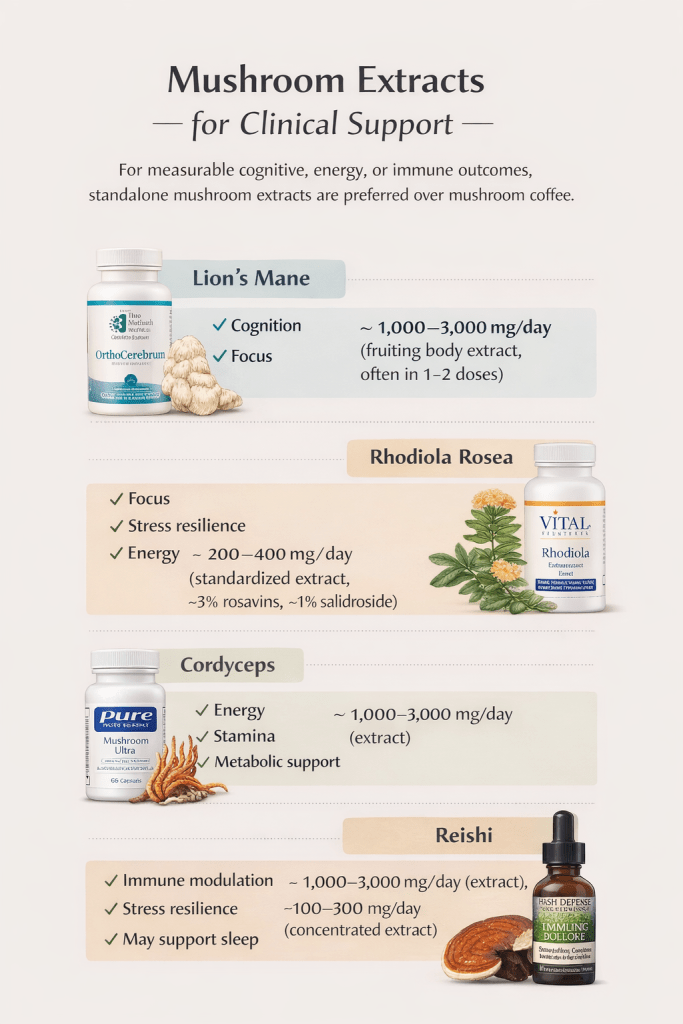
Mushroom coffee typically contains low-dose mushrooms, intended for daily lifestyle support—not clinical outcomes. For targeted goals such as cognition, fatigue, immune modulation, or stress resilience, standalone mushroom extractswith verified dosing are far more appropriate.
Common Therapeutic Dosing Ranges Used in Practice
Lion’s Mane (cognition, focus, memory)
- ~1,000–3,000 mg/day of fruiting body extract
- Often split into 1–2 doses
Rhodiola rosea (focus, stress resilience, energy)
- ~200–400 mg/day
- Standardized extract (~3% rosavins, ~1% salidroside)
Cordyceps (energy, stamina, metabolic support)
- ~1,000–3,000 mg/day of extract
Reishi (immune modulation, stress support, sleep)
- ~1,000–3,000 mg/day of extract
- Or ~100–500 mg/day of a more concentrated extract
Most mushroom coffee products provide only a fraction of these amounts.
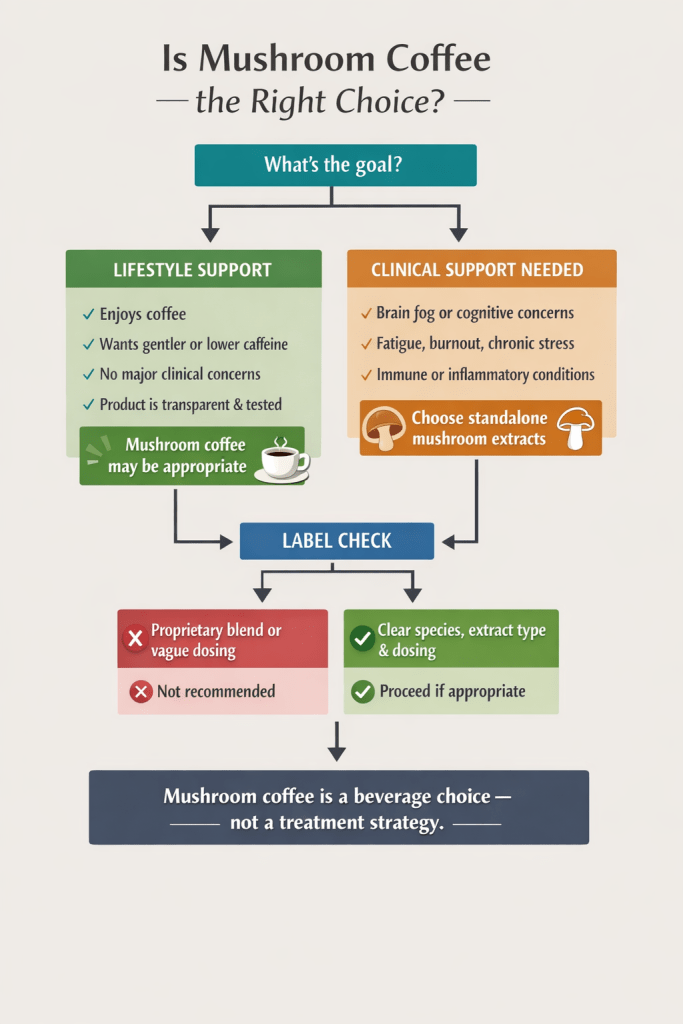
Clinical Decision Guide: When Mushroom Coffee Makes Sense (and When It Doesn’t)
Mushroom Coffee May Be Appropriate When:
- The goal is daily routine or lifestyle support
- The individual enjoys coffee but wants lower or smoother caffeine
- There are no major clinical symptoms
- The product has transparent labeling and third-party testing
- Mushrooms are viewed as a supportive addition—not the primary intervention
In these cases, mushroom coffee can be a reasonable adjunct that supports consistency and adherence.
Mushroom Coffee Is Not Appropriate When:
- The goal is measurable cognitive improvement
- The individual has brain fog, fatigue, burnout, or chronic stress
- Immune or inflammatory support is a primary focus
- Therapeutic dosing is required
- The product relies on proprietary blends or vague labeling
- Coffee or caffeine worsens GI symptoms or anxiety
In these situations, standalone mushroom extracts are more predictable and clinically appropriate.
Helpful Coffee and Caffeine Enhancers
Some individuals tolerate caffeine better when paired with supportive compounds:
- L-theanine may help smooth stimulant effects and reduce jitteriness
- Adaptogens may support stress response when dosed appropriately
- Fat-based additions (such as MCT oil or collagen) may improve satiety for some individuals
As always, individual tolerance and clinical context matter.
The Bottom Line
Mushroom coffee isn’t inherently good or bad, it’s only as good as the formulation and the goal.
- Mushroom coffee can support habits and daily routines
- Therapeutic outcomes require therapeutic dosing
- Transparent labeling, third-party testing, and quality sourcing are non-negotiable
A simple way to frame this for patients and practitioners:
Mushroom coffee is a beverage choice—not a treatment strategy.
Disclaimer (Optional Section for Blog Footer or Product Links)
The information provided here is for educational purposes only and is not intended to replace individualized medical or nutrition care. Supplements are not FDA regulated. Always evaluate product quality, dosing, and appropriateness within clinical context.
Check out my full vetted product recommendations including coffee, mushroom coffee/tea, mushroom supplements, and other enhancers on Fullscript.
 Sky Therapeutics