
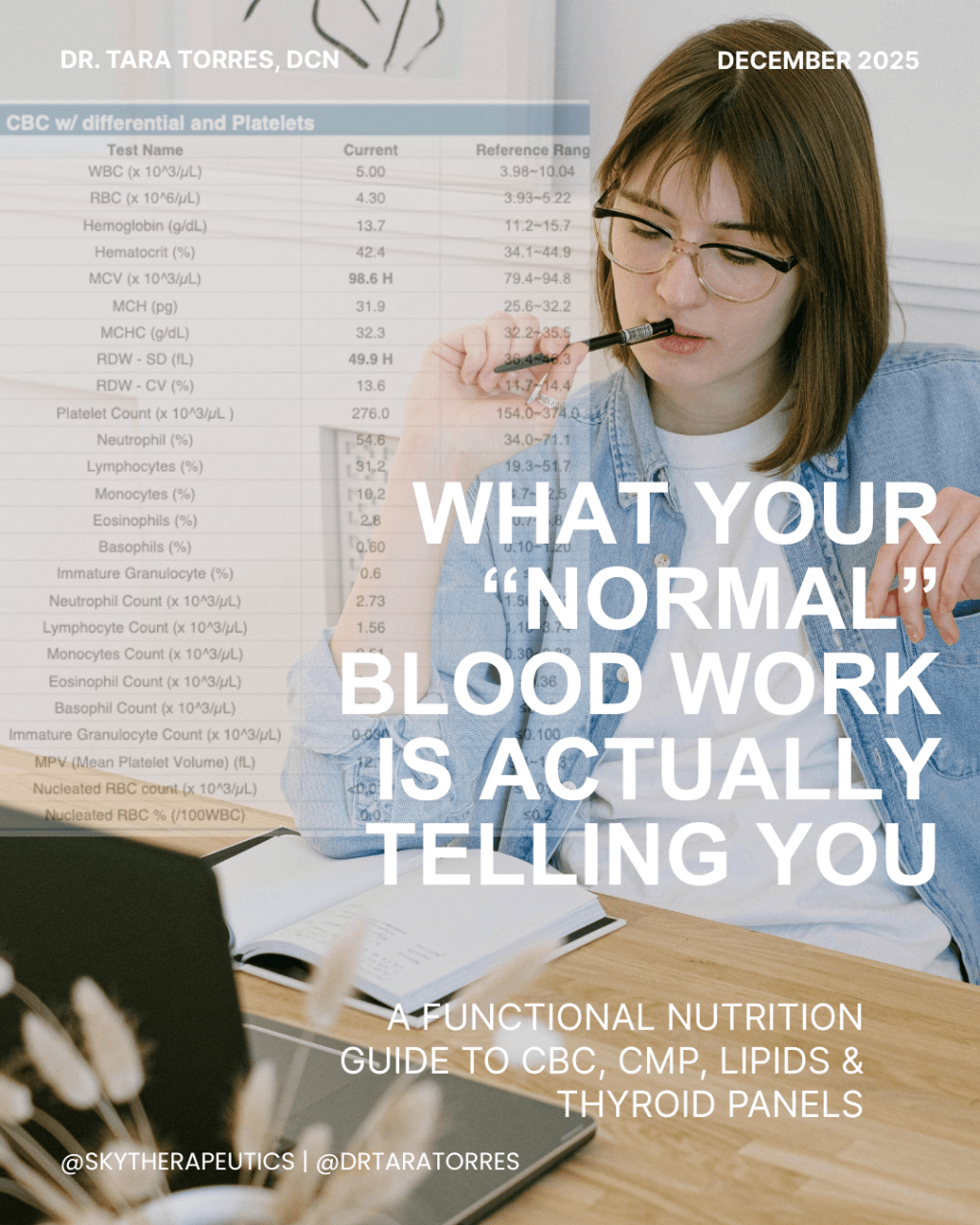
If you’ve ever had a doctor tell you that your labs look “normal,” yet you still feel exhausted, inflamed, bloated, anxious, moody, or simply not yourself, you’re not alone.
Most patients I see have been told for years that their blood work looks fine — even when their symptoms are anything but.
That’s because conventional labs look for disease.
Functional nutrition looks for direction.
Your basic blood work — the CBC, CMP, lipid panel, and thyroid panel — provides a wealth of information long before anything becomes a diagnosis. These tests reveal subtle changes in nutrient status, digestion, metabolism, inflammation, and hormone balance that traditional interpretation often overlooks.
Today, I’m breaking down these panels in patient-friendly language so you can understand what your blood work is really saying about your health.

CBC: The Immune + Nutrient + Oxygen Snapshot
Your CBC (complete blood count) reflects far more than just infection or anemia.
Red Blood Cell Markers (Hemoglobin, Hematocrit, MCV, MCH)
These tell us how well your body is transporting oxygen and how nourished your cells are.
Common functional clues:
• Low MCV → possible iron deficiency
• High MCV → likely B12 or folate deficiency
• Low hemoglobin even with “normal” iron → malabsorption, chronic stress, low stomach acid
These patterns often explain symptoms like fatigue, brain fog, exercise intolerance, or feeling cold all the time.
White Blood Cells: Your Immune Terrain
White blood cells give us a snapshot of how your immune system is functioning.
• High lymphocytes → viral patterns, stress, allergies
• High eosinophils → allergies, asthma, parasites, food sensitivities
• Low WBC → chronic stress, burnout, nutrient depletion
These patterns often show up long before symptoms peak.
CMP: Your Metabolic Dashboard
This panel reflects your liver health, kidneys, electrolytes, digestion, protein status, and blood sugar regulation.
Liver Markers (ALT, AST, ALP)
High ALT or AST can indicate inflammation, early fatty liver, alcohol load, or gut-driven stress.
Low alkaline phosphatase (ALP) is a major functional clue for:
• poor stomach acid
• zinc deficiency
• fat malabsorption
• chronic digestive issues
Glucose & Electrolytes
Fasting glucose between 90–99 mg/dL may be “normal,” but functionally it indicates early insulin resistance or stress hormones affecting blood sugar.
Low CO₂ often reflects mineral depletion and chronic stress.
Lipid Panel: More Than Heart Health
Your lipid panel tells us how flexible your metabolism is.
• Low HDL = inflammation, metabolic rigidity
• High TG = carbohydrate intolerance or early insulin resistance
• TG:HDL ratio is one of the strongest early metabolic predictors
A ratio above 2:1 indicates early metabolic changes.
A ratio closer to 1:1 is ideal.
Thyroid Panel: The Metabolism Regulator
You need more than a TSH to assess thyroid function.
• Free T4 = what your thyroid produces
• Free T3 = what your cells actually use (your energy hormone)
• Reverse T3 = your metabolic brake
• Thyroid antibodies reveal autoimmune activity years before a TSH change
Many women feel hypothyroid because they are — but their labs weren’t interpreted with functional ranges.
Why This Matters
Functional interpretation allows us to catch:
• nutrient depletion
• gut malabsorption
• early insulin resistance
• chronic inflammation
• early thyroid dysfunction
• liver overload
• stress patterns
before they become diagnoses.
Your blood work becomes a roadmap — showing us what your body needs most.
Next Steps
If you want to understand your own labs or get help interpreting unusual symptoms with “normal” blood work, you can book a visit or join any of my wellness programs.
And don’t forget to watch the full YouTube video for a deeper walkthrough.
 Sky Therapeutics