
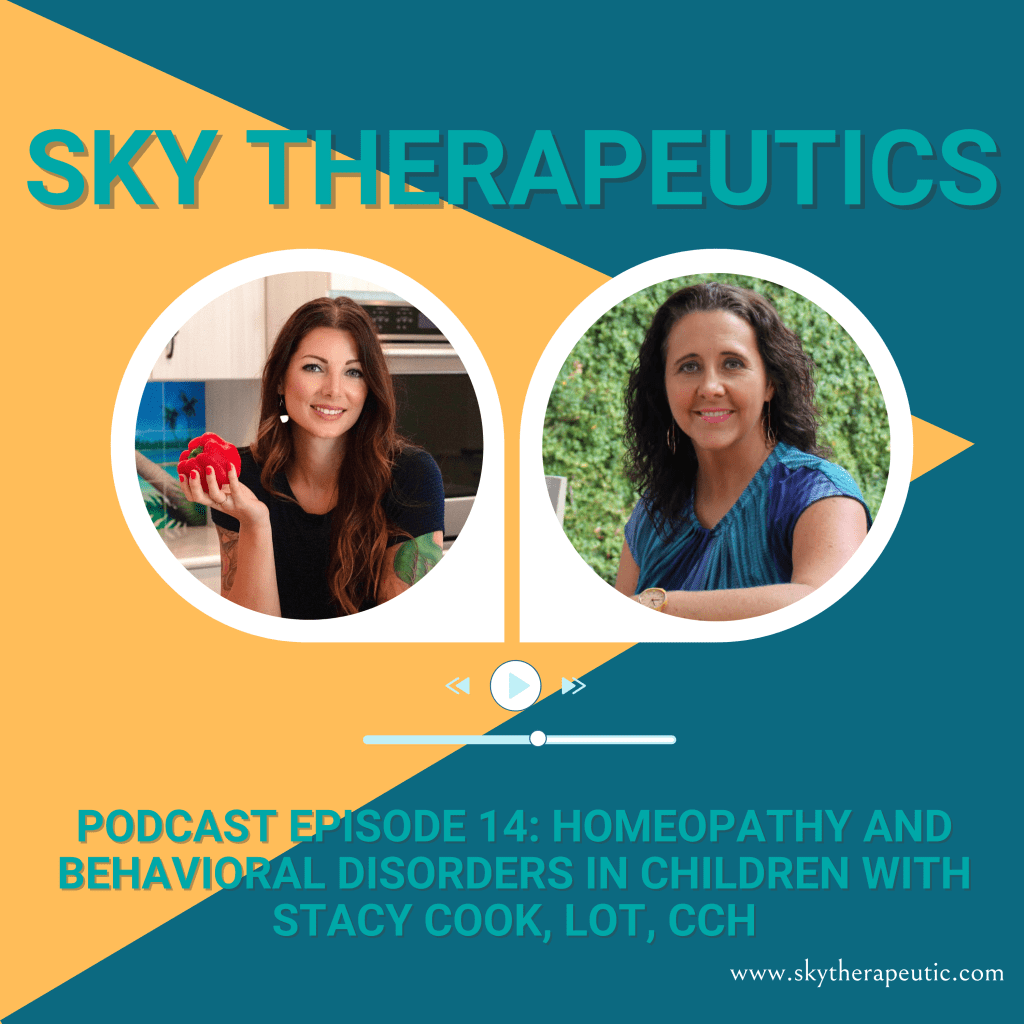
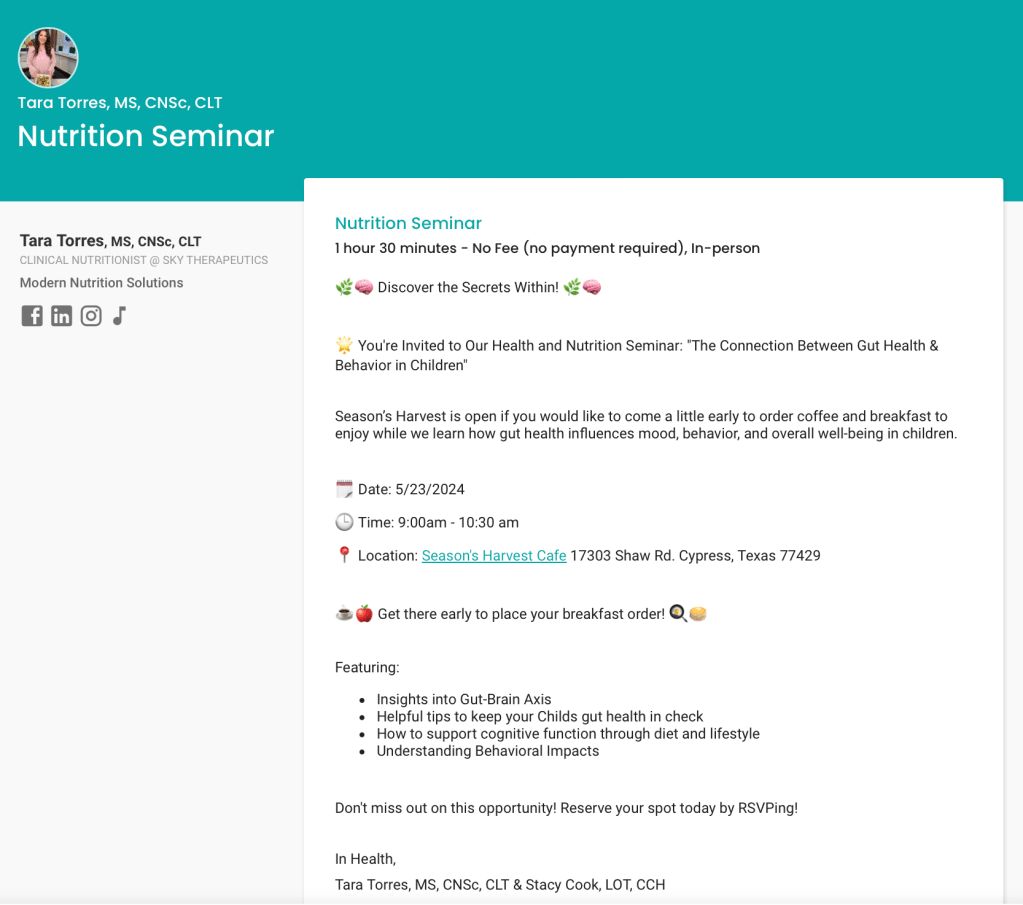
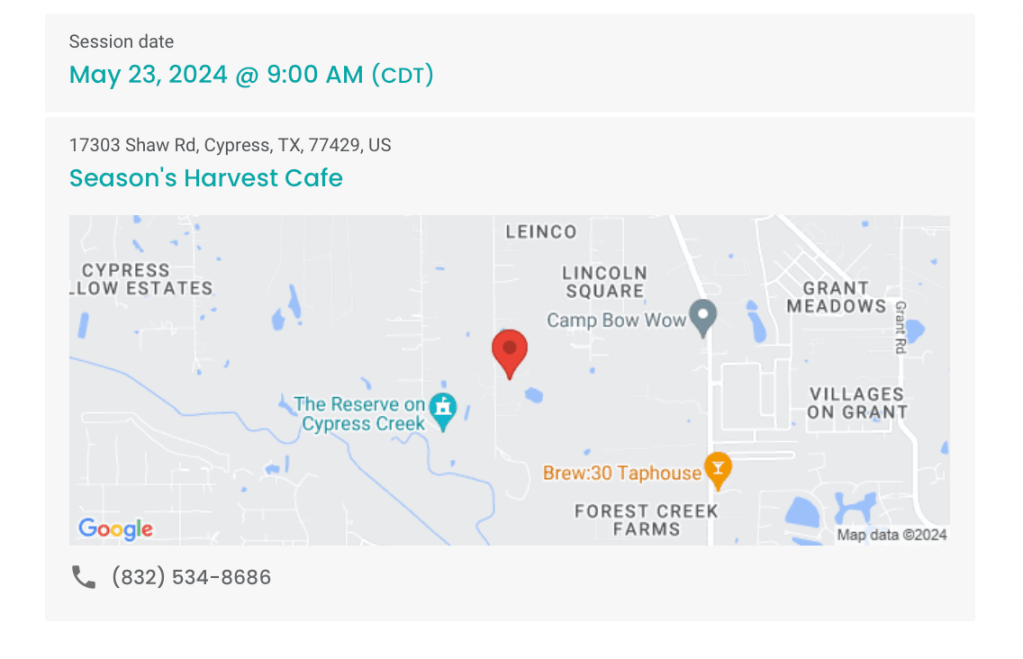
In this episode I talk to Stacy Cook, LOT, CCH of Mighty Oaks Therapies about occupational therapy and homeopathy remedies for children with behavioral health disorders. We will be hosting a seminar on the connection between gut health and behavioral disorders May 23rd, 2024 9:00 am to 10:30am at Season’s Harvest. Click here to register as seats are limited!
Check out the full transcript below*
Ms. Stacy is the founder of Mighty Oaks Therapies, a pediatric therapy office located in the outskirts of Houston in Cypress, Texas. She is a certified homeopath and a licensed occupational therapist with 20+ years of experience in the field. She is a pediatric OT working with children with developmental delays, autism, ADHD, and sensory processing disorder (among other diagnoses). But as a homeopath, she works with clients of every age. Stacy received her education as an licensed OT at the University of Texas Medical Branch in Galveston, Texas. Her additional education and certifications she received through the Energetic Health Institute & the American Medical College of Homeopathy in Arizona.
Stacy currently serves as a homeopathic supervisor through Free And Healthy Children International (FHCi). She is a health educator and partners with families to guide them in their administration of homeoprophylaxis & homeopathy. She teaches educational classes in her community addressing pediatric health as well as homeopathy. She serves nationally as a board member for the Holistic Mom’s Network (HMN). When Stacy is not working on cases, she could be found gardening with electroculture and homeopathic medicines in her yard or riding a bike somewhere in the northwest Houston area!
In this episode:
Mighty Oaks Therapies – Stacy Cook, LOT, CCH
Ready for more?
🎧 Listen on Apple Podcast or Spotify!
☎️ Schedule a complimentary discovery call today!
🍽️ FREE trial of any of our meal planners here
📚 Free E-Books and other guides here
👉 Follow us on Social Media!
Advanced Testing Offered:
💩 Genova GI Effects Comprehensive Profile (Stool Testing)
⚛️ Genova NutrEval FMV (Nutrient Deficiency & Organic Acids)
👫 DUTCH Complete (Hormones – Cortisol, Sex, etc.)
🌾 MRT170 Food Hypersensitivity (ask about our other test options)
🫀PULS Cardiac Test (Advanced Lipid Testing)
• Search/View other tests we offer here
Partnerships:
🛍️ Visit our supplement store!
🍽️ Meal Prep & Delivery: Farley’s Fit Kitchen taratorresnutrition for 10% off
🍹Curious Elixers: Code Tara10 saves you 10% off any order of $50 or more. Curious Elixirs are booze-free craft cocktails, infused with adaptogens to help you unwind.
🫖 Roots in Harmony: Specialty Tea & Superfood Blends, use code TARA for 10% off.
🌮 Siete Foods: use the code TaraTorresNutrition for 25% off
🦴 Kettle & Fire: use the code KA583994 for 25% off any Kettle & Fire products. Offer not valid on gift cards, subscribe & save or recurring subscription orders.
Full Transcript
[00:00:00] Tara Torres: Welcome to the Sky Therapeutics Podcast. I’m your host, Tara Torres, a clinical nutritionist, researcher, educator, and consultant specializing in areas of weight loss, autoimmune disease, gastrointestinal disorders, metabolic syndrome, and other obesity related conditions. I help clients improve their health through proper therapy.
[00:00:19] Tara Torres: Functional nutrition, professional grade supplement protocols, exercise recommendations, education, and support using a personalized, evidence based approach. At Sky Therapeutics, we offer functional nutrition solutions for chronic disease and help our clients develop sustainable lifestyle habits that will last a lifetime.
[00:00:40] Tara Torres: As a friendly reminder, the information and opinions provided here today is to be taken as general information only. And you should always contact your personal physician or other qualified healthcare professional if you have any questions about your personal health and wellness. Hi everyone. Welcome to this week’s podcast, where I have Stacey Cook joining [00:01:00] me.
[00:01:00] Tara Torres: Stacey is an occupational therapist with Mighty Oaks therapy. And we recently connected over a mutual patient of ours. And I was just completely fascinated with what she does because not only does she do occupational therapy, but she also does Is certified in homeopathy and she’s going to talk to us a little bit about both today.
[00:01:21] Tara Torres: So welcome Stacey. Do you want to introduce yourself and tell us a little bit about you?
[00:01:25] Stacy Cook: I do. Thank you for having me. I was live when you suggested it. I don’t know how to run a podcast myself nor am I interested, but I’m okay to be on one.
[00:01:34] Stacy Cook: I’m Stacey Cook. I am 20 plus years. I’ve been an occupational therapist, so I started my career in Western medicine.
[00:01:42] Stacy Cook: I went to the University of Texas Medical Branch in Galveston. I knew when I was going through school, I wasn’t sure which population I wanted to work in. So. Occupational therapists work in a variety of settings. They can work in an adult setting. They can work in geriatrics. They can work in acute rehab settings.
[00:01:59] Stacy Cook: They can work in a [00:02:00] pediatric inpatient setting. They can work in a pediatric outpatient setting. Well, that’s me. I’m in, I’m in outpatient. I have a private clinic that I own myself. It’s very small. It’s just me there and another speech therapist. And what I do is outpatient OT services for kiddos with qualifying diagnoses.
[00:02:17] Stacy Cook: Yep.
[00:02:19] Tara Torres: And so occupational therapy is helping people through like daily day to day tasks that they need help with, right?
[00:02:26] Stacy Cook: So what an OT does is look at your daily occupations depending on your age in life. So, you know, older adults are going to be doing different things than kiddos. So I happen to work in a pediatric setting.
[00:02:38] Stacy Cook: My, my first year as an OT, I was in adults in rehab and I liked it, but I had an opportunity to go into pediatrics and I was not convinced when I went to school that I wanted to work with kids. I was like, no way they’re germy, blah, blah, blah. No, I love it. It’s. The love of my life is are my kiddos and their moms.
[00:02:56] Stacy Cook: I mean, I love connecting with my family. So, yes, [00:03:00] as as an OT in a pediatric setting, I work on what a kiddos daily occupation would be. So, you know, there are who work in, like, a work hardening setting where they’re getting doing, like, functional capacity evaluations, and they’re helping helping people return to work.
[00:03:15] Stacy Cook: There are people who’ve had stroke and. myocardial infarctions and they’re working on rehabbing them back to full function. But in a pediatric setting, it’s a little different. It depends on which diagnosis they come in with. So if someone comes in with a the parent brings a kiddo with down syndrome in, we’re going to be looking at First and foremost, their low muscle tone and what is that impeding as far as daily function.
[00:03:39] Stacy Cook: Can they get up off the floor independently? Can they get onto playground equipment? Because a kiddos, one of their occupations is to play. That is one of their main occupations. So I’m going to look at different obstacles to function and assess what they need from me. But I work with a variety of diagnoses in my OT setting.
[00:03:59] Tara Torres: Okay. [00:04:00] So let’s talk about some of the other ones. Cause that makes sense to me. Somebody who has a physical disability, who needs help kind of navigating that. Now, before I ask you about other conditions, how is what you do different than say, like a physical therapist? Who’s maybe more exercising them.
[00:04:17] Stacy Cook: Yeah. Yeah, even our billing codes are a little bit different. I’m typically billing a code for insurance purposes of therapeutic activities. So it’s a little more encompassing and more activity based. PTs are often, they can bill therapy activities too, but oftentimes they’re billing for therapeutic exercises.
[00:04:36] Stacy Cook: So it’s going to be real, really about range of motion. Yes, there’s function too, but about Strengthening about activity tolerance, which is some endurance for tasks. So they’re going to be looking at also their lower body a little bit more than an OT is. I’m going to be looking at upper body when we kind of just split the body and, you know, and I’m going to look for fine motor deficits.
[00:04:57] Stacy Cook: I’m going to look for sensory [00:05:00] deficits as well in the physical realm. And that’s something an OT is going to be your person to go to in regard to like sensory deficits. Okay, so that makes sense. So how do we apply that to kiddos who maybe don’t have a physical disability, but maybe more of like a mental health disability, right?
[00:05:18] Stacy Cook: So, you know, OT got its start way back in the day after a world war and they were employed to help people. Soldiers reach turn back to functional occupation, whether they had a limb lost or just recovering from injuries rehabilitation and their job was to get them back to function or doing occupations daily.
[00:05:36] Stacy Cook: So they had purpose and meaning. So yeah, I mean, if a kiddo comes in and There’s no physical limitation there. Then what I’m going to look at is what the parent is telling me in regard to cognitive or even behavioral or sensory based deficit. So, if there’s a cognitive cognitive impairment, there may be other practitioners that need to work on that case.
[00:05:58] Stacy Cook: If there are behavioral [00:06:00] deficits, I’m going to look at well, we’re going to talk about that later. My homeopathic. stint as well. But there may be gut microbiome stuff going on with that. Sometimes behavioral comes down to can they sit still in a chair? Is the teacher giving the parents reports like, you know, he knows when I say what is 14 plus three?
[00:06:21] Stacy Cook: He knows the answer is 15, but he’s running around the room and climbing up the cabinets while 15, right? So, so those are things I’m looking at. What is the underlying issue going on? That he cannot sit still like his, I guess, typical peers and give that answer. Is there something internal going on? And so usually there’s a sensory based deficit going on with that, that I’ll look at, and then behavioral, a lot of times there’s sensory dysfunction or metabolic dysfunction or gut, gut disruption that’s going on, that’s fading, feeding into behavioral issues.
[00:06:53] Stacy Cook: Yes. And OT is going to use external AIDS to help with behavior. So a lot of times, you know, I look at [00:07:00] a case and I may see, I know exactly this is probably a gut issue, but absolutely as an O. T. I can look at visual AIDS because a lot of kids with sensory deficits, they use the sensory system that is working very well.
[00:07:12] Stacy Cook: And for many kids, it’s their visual system that has nothing to do with wearing glasses. It has to do with the sensation. Is the information coming in? being interpreted well, sent to the brain well and interpreted or modulated well in the brain. And visual system tends to be the one that’s working best.
[00:07:28] Stacy Cook: So this is why we see kids like this all the time, right? Because their, their visual system is where they stay because it’s the easiest, it’s the easiest to feed. It’s the easiest, it’s the best one working and their body’s kind of going crazy. And your parents will tell me all the time, he cannot sit still unless the graphics are in front of his face.
[00:07:45] Stacy Cook: I’m like, Oh, that’s because he’s using the one. system that’s working well. We need to work on the other systems. So you use an approach where you stay in the system that’s working well while diving off into the systems that are not and see what we can do to both [00:08:00] rehabilitate. or compensate for any deficits that have been identified.
[00:08:05] Tara Torres: Okay. So do you see a lot of these types of kids or adults with eating disorders or issues swallowing maybe, or maybe they’re having sensory issues and how do you help them navigate that?
[00:08:18] Stacy Cook: So a speech therapist often has certifications in swallowing deficits. But yes, there are kiddos who have sensory based texture aversions or taste aversions or even temperature aversions going on.
[00:08:32] Stacy Cook: A lot of times this is metabolic in cause, right? So that’s a whole different piece to that puzzle. But yes many parents have come to me and said, Hey, my kiddo is a picky eater, severely limited diet. We’ll only eat these five foods. I mean, that’s how you and I met because I was looking for someone who could really help from the functional nutrition part because that’s not my background.
[00:08:54] Stacy Cook: My background is therapy, you know, Western medicine. I’m also a homeopath, so I use homeopathic remedies to [00:09:00] help kiddos too. But there are, there are definitely sensory deficits that are contributing to taste, temperature and texture of versions that cause kids to severely limit what they’ll eat. But another piece of it, and again, we can talk about it when we talk about homeopathy, what is that?
[00:09:19] Stacy Cook: You know, our gut microbiome dictates what were to be fed. I mean, that is the truth of the matter. So if you have, you know, An excess of Candida in your gut, you know, that is who is telling you me. Okay. Me as an adult, you know, if I’m laying in bed at night, I’m like, I really want to eat a whole bag of Twizzlers.
[00:09:38] Stacy Cook: That’s not me. Those are Candida telling me, go feed us, please. You know, that’s not Stacy. So recognizing that. And I think that’s been a newer piece as part of the puzzle as an OT teaching parents that. This behavior right here. That’s not your, that’s not your girl. That’s not your boy. That is his, his or her gut talking and causing this.
[00:09:59] Stacy Cook: Let’s get [00:10:00] more to the crux of what’s going on. And I’ve really been able to incorporate that, excuse me, since becoming a homeopath to help educate parents on. Oh, and, and I mean, I’ve met kiddos and I’m like, you haven’t even met your kiddo yet. This is behavior from that gut. And and we’ve been able to kind of structure things differently based on that information due to research and studies and training that I’ve done.
[00:10:24] Stacy Cook: But yes, that is definitely playing a role in behavior nowadays. Yeah, and I think that’s something that we have in common between homeopathy, occupational therapy, but also functional medicine is what my background is in nutrition is, but it’s addressing the underlying root cause. And I think in order for us to get the most effective customized.
[00:10:46] Stacy Cook: You know, treatment plans to these people is to understand what exactly is causing it. And I think there’s a big difference between a candida overgrowth that we can potentially control and eradicate and then subsequently fix their cravings and all of that [00:11:00] versus something that’s inherently like associated with autism.
[00:11:03] Stacy Cook: A lot of times we’ll see cravings for carbohydrates in that way. Right. And those are two very different things. We’re treating those two very different ways. Like you mentioned. Yeah. So how did you get into homeopathy? Were you just seeing all these people and just kind of trying to figure out ways to better support them while you say all these people know it started with one kiddo.
[00:11:24] Stacy Cook: So, you know, I love, I’ve been an OT for over 20 years. I love my kiddos, but my favorite part of my job is talking to moms. I mean, in dads too, I see dads all the time, but it’s mostly mamas that I’m talking to. And, you know, that’s, seed was planted in my heart long ago with talking to moms who really just wanted answers.
[00:11:45] Stacy Cook: What is going on with her? Why have things gone wrong with his development? What is the issue going on? And having those types of conversations is what brought me here today because I saw just that yearn and that need in moms [00:12:00] and they were like, just, I want more answers than what I’ve gotten. And it was a mom in, you know, the last 10 years of my career who set me off on this course to become a homeopath.
[00:12:10] Stacy Cook: So I remember having conversations with mom years ago, you know, Stacy, I’m reading about heavy metals playing a role in my daughter’s autism, you know, and I used to work at this fish market and, and I ate a lot of fish in pregnancy and could it be this and having these. non therapy, nutritional or different type of conversations that really sparked it in me.
[00:12:33] Stacy Cook: But it was a more recent combo with a mom at my last job before I owned my own clinic that she brought her kiddo in. I had been his O. T. Since he was two. He was now four and he had not Spoken a word since I had met him. And he had been you know, had, had regressive autism where he was developing fine.
[00:12:51] Stacy Cook: And then overnight he wasn’t and had encephalopathy and had be hospitalized. And, you know, things were troublesome from there. And so the mom had [00:13:00] started exploring alternatives for him and the nanny had brought him in one day. And she said, I have to show you something. And literally he was, they were holding like something that was pretend microphone up to his mouth.
[00:13:11] Stacy Cook: And he was talking and I was like, Oh my God. What? I mean, it was four, you know, and I was like, this kid has spoken no words, you know, and it was like overnight and it was a flood. A floodgate had been open. And so, you know, as speech therapists, as PTs, as OTs, we’re always looking like, what is the block? Why can’t we get this kid to talk?
[00:13:29] Stacy Cook: What is there? And it was that day that I, I mean, it was like an epiphany for me. I’m like, this is metabolic. This is absolutely internal, that there are things that are so Simply blocking the brain from sending those signals to the mouth to be able to speak. Like for me, that was the, the aha moment for me.
[00:13:47] Stacy Cook: And when I started the nanny was like, you have to talk to mom about what she’s doing. So I did, I had a great conversation with the mom. She’s like, well, it’s called homeopathy. That started me on a, because again, my whole career was based on having these conversations with moms [00:14:00] who were desperate for new development, but also desperate for answers about what had gone wrong.
[00:14:06] Stacy Cook: So as an OT, I mean, I didn’t grow up in like a crunchy household where we did like bees, honey, fresh out of the garden, blah, blah, blah. I didn’t do any of that. I was like, you know, where’s the NyQuil, where’s the this, you know? So, so this was all new for me. I, I’ve met homeopaths who’ve been doing this for a long time, but for me, I was like, no, I need to teach parents about this.
[00:14:26] Stacy Cook: So that’s what started my, my path on. my journey to become a homeopath. So I started telling my other moms who were interested, who were open to it about what was going on with this kiddo. And I had a few that took me up on the offer and I helped look for homeopaths that were available to do virtual appointments.
[00:14:44] Stacy Cook: One we found in California, one was here in Texas and they started getting their kids case taken. And I was like, When I started hearing the moms, you know, giving me feedback and I started doing my own research, I was like, that’s it. This is, this is the block that kids have needed [00:15:00] to, the obstacle that kids have needed to traverse.
[00:15:03] Stacy Cook: And I want to be one of those people who can help remove these obstacles. So I put myself through homeopathic school and three years later, I was a homeopath. So that’s how I became a homeopath. And that is what I’ve incorporated into Mighty Oaks therapies. I am definitely still an OT and I do OT sessions.
[00:15:18] Stacy Cook: You know, every week. But I also take homeopathic cases, but not just pediatric cases. I take zero to 100 cases. Okay. Okay. So, and homeopathy has been around for a long time. I was looking up, I mean, I think it started in like the 18th century by a German physician. So yes, he’s a German physician who was disenfranchised with bloodletting and leech pudding and blah, blah, blah.
[00:15:39] Stacy Cook: And he was like. There’s got to be other things. He put forth a theory, tried to, you know, or a hypothesis, tried to make it into a theory. And he was right. Does the energy of a plant mineral or animal substance? Can it chase out the energy of a disease basically? And he proved himself right with, you know, China fish.
[00:15:57] Stacy Cook: So cin Peruvian [00:16:00] bark is, you know, what he used as the first remedy. And it really basically eradicated malaria symptoms. So we do have in our planet still today a beautiful tree bark remedy that can help. Chase out, you know, malaria symptoms if, if we ever have a malaria pandemic, right? But there are so many things that have been proven since then, you know, material substances that have been turned into energetic substances that have been proven.
[00:16:24] Stacy Cook: Approving, approving is where you have 20 to 40 healthy adults try out the remedy and whatever symptoms they manifest. Again, it’s producing artificial disease because it’s from nature and whatever symptoms they manifest. It’s recorded into a repertory and those are the symptoms that it should chase out in the real disease.
[00:16:42] Stacy Cook: So when cinchona bark is taken and it produces all these malaria like symptoms and you give cinchona to a person with malaria, healing happens.
[00:16:52] Tara Torres: Okay. Because the, the basic principle is like. Cure is like, and I think I, the way I can relate to that is, and I [00:17:00] see it in allergist and how they’re treating allergies by exposing these patients to like low doses of the actual allergen, is that the same?
[00:17:09] Stacy Cook: Well, and the thing is, though, and I don’t know the ins and outs of allergist and what are in their formulas. I have not done that research, but. My guess is that it’s not homeopathically prepared. So a homeopathic remedy also would be labeled as so if it is correct me a homeopathic remedy. It has been potent ties.
[00:17:27] Stacy Cook: So what a potent tie substances is that it’s been succused and diluted. Succussion is basically where you shake up the energy of those atoms as particles of the plant mineral or animal substance, right? Dilution is where you dilute the substance into having less atoms in the substance that you end up with.
[00:17:47] Stacy Cook: So let’s say I took, let’s do an animal remedy. How about sepia, which is the ink of a cuttlefish found in the ocean. It’s an ocean remedy, right? So it takes on properties about that. It’s an animal [00:18:00] remedy. It has animal remedy properties and it’s It’s got iodine associated with it. It’s very good for hormonal stuff.
[00:18:06] Stacy Cook: So sepia, which is the ink of the cuttlefish. Let’s say we took one drop of cuttlefish ink and put it in a vial. And then we took 99 drops of a pure water alcohol solution. A one in a hundred drop would be a one C okay. If you took it from an original tincture of ink or that substance, if I took one drop of that one in a hundred dilution.
[00:18:27] Stacy Cook: It’s already diluted 1 in 100 and put it in the next file and added 99 more drops of water alcohol for purity purposes solution, then it would be, you know, a two C. So then each time you dilute, you’re taking from the already diluted substance. And it’s hard for people who like me, when I was going to school, I was like, no, just no way.
[00:18:47] Stacy Cook: Because I couldn’t, I had my head in Western medicine. I was like, how can it be that you’re going to take so much of that original ink? from the cuttlefish and you’re going to dilute it. But the thing is, it takes on a [00:19:00] healing quality whenever you have less in that substance. So sometimes when I do in person homeopathic trainings for my community, I do some free here locally in Cypress, Texas.
[00:19:15] Stacy Cook: This is what I do. I’ll bring a jar, like a little mason jar with one marble, and I bring a mason jar full of marbles. If I shake that jar full of marbles, this is just an example using kinetic energy, right? Because we’re talking about an energetic substance. If I shake that jar full of marbles, you’re going to hear them scratching and crunching, you know, glass marbles up against each other.
[00:19:33] Stacy Cook: It’s going to have energy in that bottle, and you’re going to hear this low rumble in there. But if I shake the jar with one marble, The noise is ridiculous. You know, it’s going to be glass crashing against each other. It’s going to make a lot more energy when there’s less inside of that jar. So think about that in terms of dilution of homeopathic remedies, the less there is of the actual mother tincture or the original substance, the more potent it is.
[00:19:58] Stacy Cook: So a one C [00:20:00] is way less potent than a hundred C when you’ve diluted it a hundred times. So yes. You’re going to take a remedy that produces similar symptoms to someone who is sick and you will have it diluted and succused. Every time you dilute that potion and you have to succuse it, shake up those atoms to activate it.
[00:20:17] Stacy Cook: And the more you potentize it, the more healing that property, no, that substance, the more healing properties that substance takes on. Okay. So the greater the dilution, the higher the potency. And you’re typically taking these in pellets, liquid drops, tablets. Like how do you give this to people? So my kiddos have a lot of oral aversion.
[00:20:40] Stacy Cook: So I, what I’ll do is I even use tinctures or medicating post op. potencies of them in a liquid alcohol form. Or some kids can take pellets. They like to crunch the pellets. But yeah, they could be dropped on. Some people will say, Oh, it’s just sugar pellets. Okay, well, yes, there are sugar pellets involved.
[00:20:57] Stacy Cook: But the tincture, the liquid tincture of the [00:21:00] actual substance is dripped onto the outside of that little sugar ball, and it just makes for easy administration. So a lot of homeopathic remedies come in. easy to administer little vials where you just twist into the cat. That way you don’t touch the actual sugar ball because the tincture again is dripped on the outside.
[00:21:18] Stacy Cook: So when you twist it into the cat, you can just throw it into the mouth. So my kiddos who have, I mean, they have kiddos who will not even go for that, even if it’s sweet tasting sugar and there’s no change to the remedy. It just tastes like sugar in the ball. But I have kids who will not eat something like that.
[00:21:32] Stacy Cook: So what I’ll do is I’ll either use a medicating potency and dilute it in water, or I’ll drop three sugar balls with tincture on the outside into a little dropper, one dram dropper. And then the parents can, you know, squeeze off the lid and drop it into their mouth when they can catch up and get the remedy into their mouth.
[00:21:48] Stacy Cook: I’ve had moms dose when they’re asleep, just Drip it when their little mouth is there and drip it into the, you want the remedy to touch the mucosal membranes of the mouth so that that energy can be received by the body [00:22:00] and interpret what it needs to do with it.
[00:22:02] Tara Torres: Okay. Yeah, that makes sense. So are there any safety concerns or side effects, risk factors, anything associated with this that we need to be aware of?
[00:22:10] Stacy Cook: So if you take a remedy that is not well indicated for you, like people can access a small amount of remedies at their local health food store, you know, I know Whole Foods was carrying for a while, you know, sprouts even HEB, I live in Texas, so that’s a big store here, but they have a little row of homeopathic remedies.
[00:22:29] Stacy Cook: You could go and see one that’s for cough. And if you take that remedy and let’s say you. have a headache after that remedy. All you need to know is that that remedy is not indicated for you. You need to kind of go elsewhere because it’s not a good indication. That doesn’t mean you now have headaches forever.
[00:22:44] Stacy Cook: That doesn’t mean you have a new symptom that you’re stuck with. No, no, it’s your body reacting to the remedy. Like I don’t need that. I need a different energetic signature of a different Plant mineral animal. So if something like that happens, you simply stop the remedy, right? Sometime when I, when people [00:23:00] have had responses to remedies, I call it a remedy response.
[00:23:03] Stacy Cook: That’s not favorable. I have to listen to the case and say, but hold on a minute. Are we, is this just an aggravation? Are we going to work through this? Let’s say I give a remedy that has caused the body to release some junk. Right. Let’s say I give a remedy Illumina and the body has decided, Oh, the energy of this Illumina mineral remedy, that’s a mineral is greater than some of the aluminum deposits I have in my body.
[00:23:28] Stacy Cook: It will make, it may cause the body to release that. And if your body has a great GI tract, well, it might just poop it right out. If your body does not have a great GI tract, you might have some backup. So see how it’s. It’s good that the body is responding to the mineral by releasing junk. But if you don’t have a body or a terrain that can do the work, then you have to circle back and say, okay, how can we now support your body?
[00:23:51] Stacy Cook: Do you need some magnesium citrate that would help with peristalsis to get rid of junk, right? So we don’t want this, you know, staying in the body and being recycled, right? [00:24:00] We want your body to eliminate it. That’s the So that’s what you could expect like a remedy response. But again, sometimes you’ll take a remedy and nothing.
[00:24:08] Stacy Cook: I’m always more concerned if I give a remedy and they’re like, nothing has changed. I’m like, I’ve got to go back to the drawing board because I want a case moving forward. That’s my goal is to help people feel better and to hear that. Nothing has changed. We need a new remedy. We need a different potency.
[00:24:24] Stacy Cook: We need to dose it differently. If someone, and sometimes responses to remedies that aren’t favorable are easily fixed. If someone says, Stacey, you gave me, you know, let’s say sulfur remedy, that’s another mineral. And now I’m having trouble falling asleep at night. And then we look at what we did. Oh, it’s because I told you to take it night.
[00:24:41] Stacy Cook: The fix is you’re going to take it in the morning, you know? So sometimes it’s just a matter of tweaking. And this is why you would choose to work with a homeopath for people who don’t really know remedies. They don’t know the materia medica, the The set of properties that that this substance has taken on to heal in the body.
[00:24:58] Stacy Cook: And if you don’t know about [00:25:00] potency and dosing your homeopath would know. Yeah.
[00:25:03] Tara Torres: Okay. And that’s really interesting that you mentioned that because I can correlate that to some of our gut protocols when we’re trying to help somebody with, you know, rebalancing their gut microbiome. Sometimes we can have what we call die off symptoms.
[00:25:17] Tara Torres: And so somebody who’s maybe more constipated might become more constipated or have the opposite effect and become looser, you know, and vice versa. And we call those die off symptoms, but like you said, there’s, there’s workarounds to that. And a lot of times it’s a good sign that we actually were shaking things up and that things are dying off.
[00:25:34] Tara Torres: And like you said, we want those people going so that we can eradicate those and get them out of the body.
[00:25:40] Stacy Cook: That’s right. The goal is to ship the case forward, not to go backward. And another, there’s another term in homeopathy I want to bring up. It’s called returnable symptoms. So let’s say I had a mom give a kiddo, I took the case and I say, mom, this is our remedy.
[00:25:54] Stacy Cook: We’re going to start here. And let’s say that she says to me, you [00:26:00] know what, Stacy, we’ve been a week on the remedy and you know what, he’s doing something he hasn’t done in like three years. Like he’s eight now. He hasn’t done this since he was five. Oh my gosh. Is this, is this back? I am never, two things I’m never sad about.
[00:26:14] Stacy Cook: I’m never sad when a mom reports or a dad. A return of old symptoms, because you can look this up in homeopathic materials and teaching, teaching resources. If there’s a return of old symptoms, oftentimes this indicates we are moving in the right direction because homeopathic prescribing and then subsequent healing occurs in an order.
[00:26:36] Stacy Cook: It occurs from the top down. In other words, I want to see that your depression is starting to be obliterated and removed. Before, let’s say your hip alignment comes into play, right? I want to see you moving from the top down. I want to see that you’re, and then from the center out, right? You’re more vital organs to your distal, right?
[00:26:53] Stacy Cook: So I want to see that your heart palpitations have started, that they’re obliterated or they’re gone before your [00:27:00] ganglion cyst in your wrist, right? So I’ll know that I’m moving in the right direction. And the other thing, this is all according to Herring’s Law of Cure, these three principles. The third one is in reverse order of occurrence.
[00:27:10] Stacy Cook: So if someone says to me, you know, I had a car wreck two weeks ago and tell me their symptoms from that. And then they say, and then 10 years ago, I I don’t know, I developed a chronic cough. Well, I’m going to be seeing probably the more recent injury starting to abate and be done before that chronic cough.
[00:27:30] Stacy Cook: That doesn’t mean we won’t get there, but see how it works in reverse order. You’re more recent symptoms as opposed to your more chronic and long term. So it’s the same thing when a mom tells me, Hey, we’re back to where we were five years ago. I’m like that. I’m not, I’m not sad. I’m happy because this and this and this is better.
[00:27:47] Stacy Cook: I’m not worried that that’s returned because it’s like we peeled off a layer. And we’re at a new layer that includes what you were dealing with five years ago, and that was probably just suppressed and never really healed. Right? So, so that’s another thing I wanted to [00:28:00] bring up. Return of old symptoms I’m never sad about and fevers.
[00:28:03] Stacy Cook: I love fevers.
[00:28:05] Tara Torres: Yeah. Oftentimes that means like your body’s doing what we want it to do. It’s fighting off. The infection or whatever. Right.
[00:28:12] Stacy Cook: That’s right. I always am prompting moms, mom, whatever you’re comfortable with. I have remedies that I can suggest to them if their fever gets over one or two, blah, blah, blah.
[00:28:21] Stacy Cook: But if I, if there’s a mom that’s like, yeah, I’ll let the fever ride. It’s not a problem. You know, and whatever they’re comfortable with in their family and whatever their doctor is comfortable with, then that that fever’s job is to burn off toxins is to recalibrate the body. So. I’m never sad when a kiddo spikes a fever after a remedy because I know that we’re moving in the right direction.
[00:28:40] Tara Torres: Yeah. Yeah. Same. I also, I was looking up that law and I remember seeing like mental and emotional symptoms being a part of that too. And I think there, I like that because I think that that’s tied in with health and physical ailments so much. I don’t realize how much those are tied together, your mental and emotional health [00:29:00] with your physical ailments.
[00:29:01] Stacy Cook: Right. I just took a case yesterday and the mom has done a great job of just kind of, it was a behavior case and, you know, she was, she’s done a great job of. Thinking about these things. And she’s like, I figured it out. This happens when such and such events occur every week or month or whatever. And it’s completely psychosocial that triggers this behavior.
[00:29:22] Stacy Cook: And I’m like very good research mom, because that’s going to help me in selecting the right remedy. Because that’s an important piece to our health is the mental and emotional aspect too. Right, right. A friend of mine was telling me she did treatment for eczema and she said during the treatment, she.
[00:29:40] Stacy Cook: First, her stomach got better. She started to notice like she had indigestion and bloating. But then she noticed other happy things. So not only did her gut health get better and then her eczema, but she had less joint pain and stuff.
[00:29:52] Tara Torres: And I think people don’t understand like the interconnectedness of all of these systems together.
[00:29:58] Stacy Cook: Absolutely. An eczema is [00:30:00] absolutely a gut microbiome issue. Absolutely right. The digestive tract is tied to so many different things. And if your digestive tract, your GI tract cannot eliminate, well guess what your largest, largest excretory organ is? It’s your skin. So it’s going to use the skin. So I’m always talking to my clients.
[00:30:19] Stacy Cook: If your skin is being utilized to excrete, It’s because you have a liver that’s overburdened. You have a GI tract that can eliminate. So we’re always talking about these things for sure.
[00:30:29] Tara Torres: Yeah. So are there homeopathic, homeopathic, homeopathic treatments for detoxification and how do you support that?
[00:30:39] Stacy Cook: It’s so funny when people say homeopathy and then they have people saying homeopathic, it’s like the syllable is different.
[00:30:46] Stacy Cook: Actually, can you repeat your question?
[00:30:47] Stacy Cook: Are you saying homeopathic remedies for GI tract stuff?
[00:30:51] Tara Torres: Yeah. So I mean, we were just, you had my brain going, we were talking about the gut health and, and then, and I’m like, okay, there’s so much like die off and toxins. And then, you know, [00:31:00] anytime we’re sick, we’re trying to promote the detoxification of things. So what are you giving people or what are like your best recommendations for people? Are there any tips and tricks and certain things they should look for if they’re going to sprouts to get some of these?
[00:31:12] Stacy Cook: Well, yeah. So if you go to sprouts, they have like a trifold, like a display rack with little chapstick tube sized homeopathic pellets are usually 80 pellets in a vial.
[00:31:22] Stacy Cook: I always tell my clients just to take one pellet at a time because one pellet is the same as five pellets. I mean, if you took them an hour apart, that would be two doses. But taking five pellets at one time once versus taking one pellet. at eight o’clock and then one pellet at 10 o’clock. That’s two doses.
[00:31:39] Stacy Cook: The amount of pellets doesn’t matter. What matters is how often you dose it. And that’s hard again for people who’ve been in Western medicine mindset to get across, but that’s true because the amount of the substance is not as meaningful as how often you take it. But on the trifold layout there, the FDA requires that homeopathic medicines are [00:32:00] represented to target a specific symptom, but that does not mean that that’s the only symptom.
[00:32:06] Stacy Cook: So for example, Nuxbomica would be there probably in a 200 C and a 30 C most remedies that you find are in a 30 C. That’s because that’s what the older remedies were made that up to that potency to start healing people. But you can get a 60, sometimes you can get a, 30 C. There are a lot of thirties that there are also higher potencies.
[00:32:26] Stacy Cook: So let’s say you go to get nox vomica. Nox vomica is the hangover remedy. We could call it for acute care. Like if you drank too much of that before, that might be a remedy that really helps you the next day when you’re dealing with it. Next day symptoms, but next Vomica is also very good for obstinate constipation, right?
[00:32:45] Stacy Cook: Next Vomica in a 200 seat is going to be very good for your emotional state. When you’re in your type a I’m driven, I have to get everything done. There’s so many qualities that that you know, healing medicinal substance has taken on. It’s not just good for the [00:33:00] one thing that is listed there. But that is where I would suggest people start because they’ve used a very prominent symptom to help guide people in selecting remedies.
[00:33:09] Stacy Cook: So if you do go and whatever, I don’t even know what they’ve listed as the symptom for nocturnal and it matches your symptom. You can start right there. If it does listed as. Chronic or obstructive or congested constipation, you could start there. Another one for diarrhea might be sulfur, right? But if, again, if you don’t respond to that remedy, it just means you need a different energetic substance.
[00:33:30] Stacy Cook: It’s not the right match for your constitution. It doesn’t mean that homeopathy doesn’t work. So if you go and read that layout at your local health food store, that will help guide you. And sometimes they have a little book there that you can take with you. And so you can read up on what might be good.
[00:33:44] Stacy Cook: Here lately, it’s, I’ve had a lot of people who are looking for lung and throat and cough issues going on. And so I’ll say go to Sprouts and see which one, you know, matches, you know, your symptom the best. For people who are not my clients, for people who are my clients, I will do [00:34:00] something more specific, but that’s a good place to start is looking at those that describe your symptom.
[00:34:05] Stacy Cook: Well, like spongia might be a really dry cough and it’s a barking sound versus like a wet cough, which might be antonium tartaricum. You could find that or a remedy there too. So.
[00:34:17] Tara Torres: What about for allergies? You would you recommend because right now it’s crazy allergy season. I feel like everybody’s complaining about it and I’m dishing out vitamin C and quercetin left and right, but the top favorites you could mention for people.
[00:34:29] Stacy Cook: Yeah, I’ll mention, I’ll mention too. So if you have a clear nasal discharge, right, it’s not yellow, it’s not green. So there’s not some other element going on. It’s just a. Mucosal membrane response to some allergy in the air, and it’s just clear liquid coming out. That’s your mucosal membrane, right?
[00:34:49] Stacy Cook: Inflamed and filling up with the liquid to stop those receptors, right? From taking in the allergen or that pollen or whatever. If you have a big nasal discharge, and you have a watery eye, [00:35:00] just a classic. A great remedy is called Allium Cepha. It’s spelled A L L I U M and then C E P A. It’s made from a red onion.
[00:35:12] Stacy Cook: And so think about when you cut a red onion, right? What happens to your eyes? Your eyes may start watering and itching. Your nose may be itchy and run. clear, not with yellow or green. So that remedy has been found to really help in hay fever and allergy issues. When there’s a lot of pollen going on, if it doesn’t help you, that just means that’s not the one for you.
[00:35:31] Stacy Cook: You may need another one, but another good remedy is called histamine. Hydrochloric that’s. A SAR code. It’s made a SAR code is a remedy made from healthy tissue, right? Your body releases histamine in response to, you know, allergens, right? Or actually in response to inflammation when it needs to create inflammation in the body to ward off an issue.
[00:35:52] Stacy Cook: And that remedy has been made from the energy of histamine. So histaminum hydrochloricum is a remedy that is really helpful [00:36:00] in inflammatory states. So I would say out of those two, that one has been especially helpful. And I know on that trifold display, that histaminum is in both a 6C and a 30C potency.
[00:36:11] Stacy Cook: So if someone just has a little bit of an issue going on, they might do fine with a 6C, a lower potency, but if it’s a little more, pervasive and severe. Like I have friends in Austin who are going or maybe they’re coming out of it now, but they were going through Cedar fever. I mean, your whole face just swells up.
[00:36:26] Stacy Cook: I would say, yeah, I get a little higher potency, the 30 C. In fact, I just did tell my friend to get in. She was like, Oh, night and day. So that’s a good remedy to help because that’s a more of an isopathic as opposed to homeopathic. Right? You use in Chona bark as a homeopathic, which is a same. No, sorry.
[00:36:45] Stacy Cook: Like, here’s like to help with malaria symptoms. Right? But this is using actual histamine histamine in a remedy in potency form to. clear out histamine from your body to get your body to calm the inflammation down, right? And so it’s saying, [00:37:00] we would call that an isopathic remedy, but it’s still prepared homeopathically.
[00:37:04] Stacy Cook: So those are two good remedies to consider for hay fever and allergies.
[00:37:09] Tara Torres: Awesome. That’s fascinating. I’m, I’m definitely going to be stopping by and checking out the little brochure and looking into it more for sure.
[00:37:17] Stacy Cook: That’s right.
[00:37:18] Tara Torres: Okay. So you and I recently discussed putting on a talk soon, and this is going to be for our behavioral disorders adults and children, but I think it’s more geared towards our kids.
[00:37:33] Tara Torres: I have had an influx of children with behavioral disorders. And so I wanted to mention that at the end of this recording, just to kind of give everybody a heads up that it’s going to be coming hopefully in April, but you and I are going to gather at a local cafe. There’s going to be some amazing food, and we’re going to put on a little presentation discussing how you and I collaborate and help these kids and grownups with behavioral disorders.
[00:37:57] Tara Torres: Because there’s a lot, I think you have a lot of [00:38:00] golden nuggets when it comes to occupational therapy and homeopathic remedies, but I also have some nutrition interventions that, you know, you had mentioned one of those remedies as being really helpful. I feel the same way about fish oil and like the impact on cognitive function.
[00:38:15] Tara Torres: So I definitely want to highlight those and allow people to answer, ask questions. When we do meet, so it’s going to be no charge on our behalf. You know, there might be some charge for food for those of you coming, but we definitely want to encourage anybody in the local Northwest Houston area to come.
[00:38:34] Tara Torres: And we’re going to open the floor to dialogue about this, ask questions, and we’re just here to support everybody and bring some different tools to the table besides, you know, conventional medicine options.
[00:38:48] Stacy Cook: That’s right. I mean, parents are very much looking for answers nowadays, you know, and I mean, I just find in my practice, everybody is sick.
[00:38:57] Stacy Cook: I mean, or has some ailments some some [00:39:00] way going on and a lot of it has to do with gut health. So that will be the bulk of what I talk about is how I use remedies to target that. But I’m excited to do that. I think we’re going to shoot for an evening time because I’ve presented there before to be your first time but I usually present in the morning, but I think in the evening it’ll be so helpful because the people, you know, won’t be worried about work and there won’t be that scheduling conflict.
[00:39:23] Stacy Cook: So, we’ll still work on the time and the date, but if people want to come great because I want to answer questions because again, people are not feeling well and they’re looking for what is going on that root cause like you caused it. So I’m excited about it.
[00:39:37] Tara Torres: Me too. I’m so excited and I appreciate you coming and joining me today and sharing your information.
[00:39:42] Tara Torres: I feel like. There’s so many more things that we could talk about for a couple of hours here, but I appreciate it. And if anybody has any questions, feel free to reach out. I’ll bring Stacey back if, if there’s anything specific, but otherwise stay tuned. We’ll be sure to let you guys know about this upcoming talk.
[00:39:59] Stacy Cook: Goodbye [00:40:00] everyone.
[00:40:00] Tara Torres: Thanks.
[00:40:02] Tara Torres: Thank you for listening to the sky therapeutics podcast with your host. That’s me, Tara Torres. Bye. If you enjoyed today’s podcast, be sure to check out any bonus info and links in the show notes. You can visit us at www. skytherapeutic. com or find us on social media because we love connecting with our audience.
[00:40:21] Tara Torres: Until next time, be well.
[00:40:24]
 Sky Therapeutics